Most London homes can fit between 10 and 16 standard solar panels, depending on roof size, pitch and shading. Jade Roofing Experts, a family-run roofing company based in Kilburn, London, offers free roof surveys that confirm exactly how many panels your roof can safely support — and whether the roof itself needs repair first.
What Determines How Many Solar Panels Fit on a Roof?
Four factors decide your roof’s solar capacity: usable roof area, roof pitch and orientation, obstructions (chimneys, vents, roof windows), and structural condition. A large, unshaded, south-facing pitched roof in good condition will comfortably outperform a smaller or obstructed roof, regardless of postcode.
| Roof Size (Usable Area) | Typical Panel Count | Approx. System Output |
|---|---|---|
| Small terrace (15–20m²) | 8–10 panels | 3.0–3.7kW |
| Medium semi-detached (20–30m²) | 10–14 panels | 3.7–5.2kW |
| Large detached / extended roof (30–40m²) | 14–18 panels | 5.2–6.7kW |
| Flat roof (commercial/residential) | Varies — frame-dependent | Assessed on survey |
What Is “Solar Panel Roof Capacity”?
Solar panel roof capacity is the maximum number of solar panels a roof can physically and structurally support, based on its usable surface area, pitch, and load-bearing strength. In London, this means accounting for older roof timbers, chimney stacks, and conservation area restrictions that are far less common in newer housing elsewhere in the UK.
How to Estimate How Many Solar Panels Your Roof Can Fit
You can get a rough estimate yourself before booking a professional survey. Here’s the method we use as a starting point:
Measure your usable roof area
Measure the length and width in metres of each unshaded roof plane facing south, east or west.
Subtract obstructions
Deduct space taken by chimneys, soil vents, roof windows, and any permanently shaded sections.
Apply the standard panel footprint
Divide your remaining usable area by approximately 1.7m², the standard footprint of a residential solar panel.
Check pitch and orientation
A pitch of 30–40 degrees is ideal in the UK, though panels perform well between 15 and 50 degrees.
Book a professional roof survey
A free structural inspection confirms your roof’s exact condition, load capacity, and panel count before any installer commits to a design.
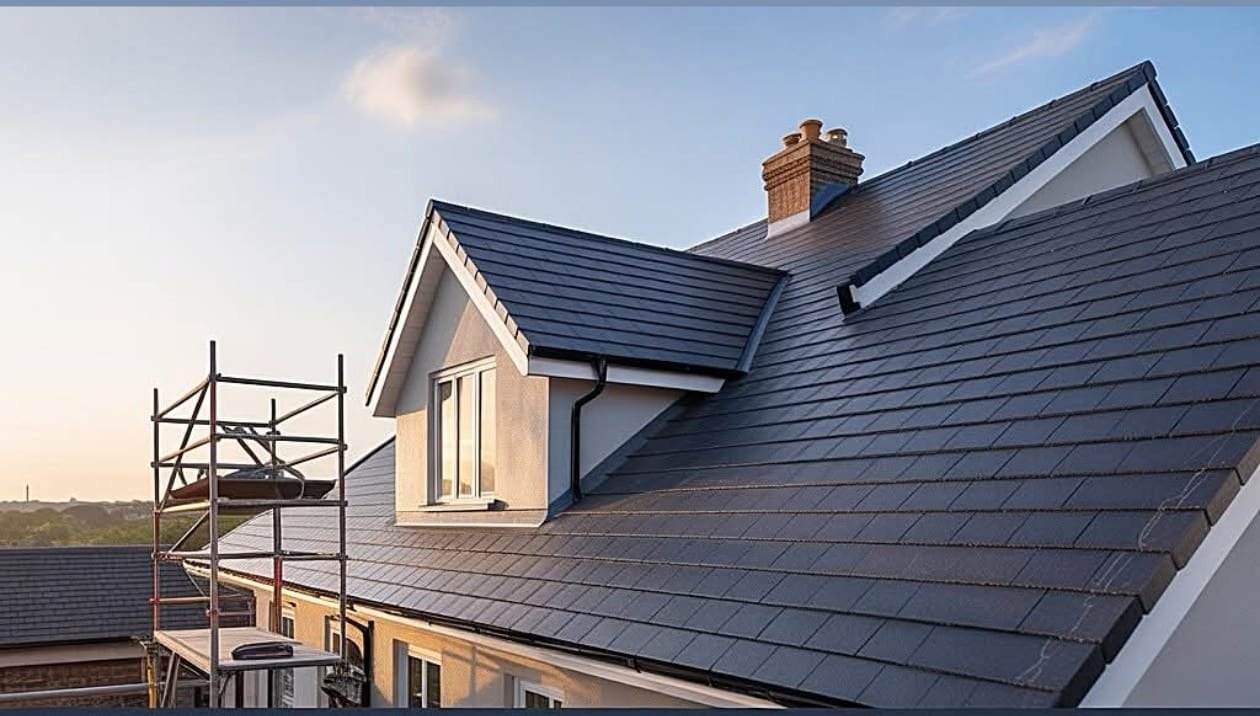
Not sure your roof can take the weight? We’ll tell you honestly — free structural roof survey across Kilburn, Camden & West London.
Solar Suitability by Roof Type Across London
Victorian and Edwardian Terraces
Victorian and Edwardian terraces make up the majority of housing across Camden, Islington, Kilburn and Kensington. These roofs typically have original timber rafters, slate or clay tile coverings, and were never designed with additional roof-mounted loads in mind. That doesn’t mean solar is off the table — it means the timber and covering need checking first.
Flat Roofs
Flat roofs, common on extensions, mansion blocks, and mid-century properties across Westminster and Hammersmith, can hold solar panels using a tilted mounting frame. The roof covering and deck should be assessed for condition and weight capacity beforehand, since flat roof membranes degrade differently to pitched tile or slate.
Conservation Areas and Listed Buildings
Large parts of Islington, Kensington and St John’s Wood fall within conservation areas, where panel visibility from the street can affect planning permission. We handle council permit applications on your behalf where scaffolding, pavement licences, or planning input is required.
— Naher Farrokh, Founder, Jade Roofing Experts
Panel Types, Wattage & Why Fewer Panels Can Mean More Power
The panel count numbers in the table above assume a “standard” 1.7m² panel, but not all panels produce the same output from the same footprint, and this is where a lot of homeowners get confused comparing quotes. A basic polycrystalline panel typically produces somewhere in the region of 300–350 watts. A modern monocrystalline panel of the same physical size can produce 400–440 watts or more, and the newest high-efficiency panels — often using PERC or N-type cell technology — push that figure higher still. In practical terms, this means two roofs of identical size can end up with very different system sizes depending purely on which panel range the installer specifies.
This matters directly for London roofs, because so many of our properties have limited usable roof area to begin with — a Victorian terrace with a single, chimney-interrupted pitch simply doesn’t have the luxury of spreading a large array across acres of tile. If your roof can only physically fit 10 panels rather than 16, choosing higher-wattage panels is often the only way to close the gap in total output. It’s a conversation worth having with your solar installer before signing anything: ask for the panel wattage, not just the panel count, and compare quotes on total kW output rather than number of panels alone.
There’s a second, less obvious factor: panel dimensions themselves vary between manufacturers, typically ranging from around 1.65m to 1.9m in length and 1m to 1.13m in width. A roof plane that fits 12 panels from one manufacturer might only fit 10 from another, purely because of a few centimetres’ difference in frame size. This is exactly the kind of detail that gets missed when a solar company measures your roof from a satellite image rather than physically climbing up and measuring the timber, the eaves, and the exact position of every vent pipe and chimney breast. It’s also why we always recommend a proper roof survey happens before, not after, a solar quote is finalised.
London Sunlight, Shading & Seasonal Output
Panel count only tells half the story — what those panels actually generate over a year depends heavily on London’s specific light conditions, which differ meaningfully from, say, the south coast or the Midlands. London receives on average around 1,400–1,600 hours of sunshine annually, noticeably less generous than Cornwall or parts of East Anglia, and skewed heavily toward the April–September window. That doesn’t make solar a poor investment here — UK solar technology is designed around diffuse daylight, not direct blazing sun, so panels still generate meaningfully even under our grey, overcast skies — but it does mean orientation and shading matter more, not less, in a city like this.
Shading is the single biggest output-killer we see on London roofs, and it’s rarely obvious from ground level. Tall neighbouring terraces, mature street trees along roads like those in Camden and Islington, chimney stacks shared between adjoining properties, and even satellite dishes or aerials can all cast partial shadow across part of an array for a portion of the day. Because most residential solar systems wire panels in a series string, a shadow falling on just one or two panels can drag down the output of the entire string, not merely those panels — unless the installer specifies micro-inverters or power optimisers to isolate each panel’s performance individually. If your roof has any partial shading from neighbouring buildings or trees, it’s worth specifically asking your installer whether they’re quoting a standard string inverter or panel-level optimisation, since the wrong choice on a shaded London terrace can quietly cost you 15–20% of your expected output.
Orientation compounds this further. A due-south roof pitch will always outperform a purely east- or west-facing one, but on terraced streets running east-west, many London homes simply don’t have a south-facing option at all — only a front and rear pitch running east and west. This isn’t a dealbreaker; east/west-split arrays are common and still viable, spreading generation across the morning and evening rather than concentrating it around midday, which actually suits some households’ usage patterns better. But it does mean the “10 to 16 panels” range quoted earlier needs to be read alongside a site-specific shading and orientation assessment, not treated as a guarantee of output on its own.
Balancing Panel Count Against Cost and Return
It’s tempting to assume more panels is always better, but the economics don’t always support maximising every square metre of roof. Beyond a certain system size, a household’s own electricity consumption is already fully offset, and additional panels only generate a return through exporting surplus power back to the grid at a lower rate than you’d pay to use it yourself. For most London households, a system sized to cover 70–90% of annual consumption, rather than 100%+, tends to deliver the best payback period, because it avoids over-investing in capacity that spends much of the year exporting cheaply rather than saving you money directly.
This is also where roof condition quietly becomes a cost decision, not just a safety one. If your existing roof covering is approaching the end of its serviceable life, it’s worth pricing that work in alongside the solar quote rather than as a separate, later job — our guide to how much a new roof costs in London breaks down what full re-roofing typically involves, and our page on roof installation costs across London covers pricing for the kind of pitched roof work that often needs to happen before scaffolding goes up for a solar array. Sequencing this correctly — roof work first, solar second — is consistently the difference between a straightforward install and one that costs thousands more in re-work.
When Roof Repair Should Come Before Solar
We inspect a lot of London roofs ahead of solar installation, and a recurring pattern emerges: minor, easily-missed defects that are harmless on their own become serious once panels, mounting rails, and roof-penetrating fixings are added on top. Cracked or slipped tiles near a proposed panel array, softened timber around an old chimney flashing, or a felt underlay already past its expected lifespan are all things a solar installer’s survey may not flag, because their focus is the panels, not the roof beneath them. Our own roof repair cost guide for London sets out realistic pricing for exactly this kind of pre-solar remedial work, and it’s almost always cheaper to address than dismantling a finished solar array to fix a leak discovered six months later.
If your roof has an active leak, storm damage, or a fault that needs urgent attention rather than scheduled repair, that’s a different situation entirely — our emergency roof repair guide covers what to expect if you need same-day or next-day intervention before any solar work can even be considered. And if your roof pitch itself is in question — whether it falls within the ideal 30–40 degree range discussed earlier — our separate guide on how to calculate roof pitch walks through measuring it accurately yourself before you ever get a solar company round.
Is Your Roof Structurally Ready for Solar Panels?
Before any solar installer proceeds, check these five things — or have a roofer check them for you:
- Roof covering age — coverings over 20–25 years old should be inspected first.
- Timber condition — rot, sagging, or historic water damage weakens load capacity.
- Weight tolerance — solar panels typically add 15 to 25kg per square metre.
- Pitch and orientation — confirms realistic output before you commit.
- Planning status — particularly relevant in conservation areas across London.
Additional weight per square metre typically added by a solar panel array.
If your roof needs repair or replacement, it’s almost always more cost-effective to do that before installation — removing and refitting panels later to access the roof adds significant extra cost. Our Roof Inspection Report service page covers exactly this kind of pre-solar assessment.
London Roof Data & Local Considerations
London’s housing stock skews significantly older than the UK average, which is the single biggest factor separating a London solar roof survey from one in a newer suburban development elsewhere in the country.
Free Download: London Roof Solar-Readiness Checklist — a one-page checklist to run through before you contact any solar installer.
Frequently Asked Questions
How many solar panels do I need to power my house?
How much roof space do I need for solar panels?
Can my roof take the weight of solar panels?
Do I need planning permission for solar panels in London?
Can you put solar panels on a Victorian roof?
Can flat roofs have solar panels?
How do you calculate solar panel roof capacity?
What roof pitch is best for solar panels?
Do solar panels damage your roof?
Should I replace my roof before installing solar panels?
How old can a roof be before solar panels become a problem?
Do I need a structural survey for solar panels?
Who checks roof suitability for solar panels in London?
Further Reading
Naher Farrokh — Founder, Jade Roofing Experts
15+ Years Experience
2,000+ Projects Completed
Naher founded Jade Roofing Experts in Kilburn, North West London, and has personally overseen roofing projects across Camden, Islington, Kensington and Westminster for over 15 years, from emergency leak repairs to full Victorian terrace re-roofs and heritage leadwork in conservation areas. All work is carried out using BBA-approved materials and in full compliance with HSE guidelines.
159 Kilburn High Road, London NW6 7HU · 07955 558880 · info@jaderoofingexperts.co.ukThinking about solar? Start with a free, no-obligation roof survey. We’ll confirm exactly how many panels your roof can safely support — honestly, with no sales pressure. Available across Kilburn, Camden, Islington, Kensington, Westminster and surrounding London areas. 24/7 emergency service also available.